Showing posts with label digital learners. Show all posts

Monday, November 12, 2012

Conversations in the cloud...


This week, I learned about yet another interesting tech tool that can be used for educational purposes in the second language classroom; voicethread. Voicethread is an online tool for collecting and recording conversations that occur around an image or a video. It is something akin to an online discussion board, except that the options for commenting are much more versatile. Not only can individuals type up their comments, they can also voice or video record them. The variety of comment formats creates the impression of a much more authentic and interactive conversation. This week, my classmates and I each  experimented with creating our own voicethreads that we might be able to use with the students in the various settings in which each of us teach. It was interesting to see the variety of topics - from characterization in literature, to Chinese culture, to Spanish verb conjugations - which my classmates chose to create voicethreads about. It was also interesting to see the variety of purposes they had their students use voicethread for.


Alicia's voicethread, for example, was created for the purpose of giving her students a forum for becoming more comfortable using their English speaking skills in front of their classmates, without actually having to stand up and speak in front of the class. Her first assignment for her students was to leave a comment telling what country they were from and to tell about some similarities and differences between their the country or culture they were from and the United States. It seems like this would be a topic of relevance and interest to her students, and as a result an effective way to get them to practice their oral communication skills. Additionally, a voicethread like this could be well suited to building a positive sense of community among learners as they listen to and learn from the unique perspectives each of their classmates brings to the question about cultural similarities and differences.

The purpose of the voicethread Alyssa made for her students, on the other hand, was a lot more narrow and specific. Rather than posing an open-ended question for the purpose of prompting discussion and conversation, Alyssa's voicethread asked her students to give three sentences to demonstrate their knowledge of how to use a specific grammatical tense; the present progressive form in Spanish. A voicethread like Alyssa's could be used quite effectively as an assessment tool after a grammar lesson and in-class practice activities on a specific grammar point. By listening to the sentences students gave in their comments, the instructor could get a pretty good idea of how well students could use the grammar in their speech, without the logistically difficult and time consuming task of conducting speaking tests with each of her students.


While these two examples show how voicethread can be used for the purpose of creating classroom community, helping students develop speaking skills, and assessing speaking skills, there are many other purposes for how this tool can be used with L2 learners or in the L2 classroom.

Friday, September 14, 2012

Cellphones, Ipads, and the Digital Learner: A Call for Reflective Use of Classroom Technology

Did you know...


 If facebook were a country, it would be the third largest in the world?


There are over 12 billion searches performed on google each month?


The number of text messages sent and received daily now exceeds the total population of the human planet?


Now that you know, how will you let it inform your teaching? One youtube video entitled Pay Attention suggests having students text individuals outside their school to gather data for the class to use in lessons on topics like graphing, food preparation, and economic trends. Since we live in an age of digital learners, this video argues, why not use the technology our students love to engage our students and teach them more effectively? Another thought provoking video, Did You Know? calls attention to the rapid technological change going on in the world today and points to the need to prepare students for jobs that don't yet exist and that will utilize technologies that haven't yet been invented.


I appreciate the arguments these videos make about the urgency of incorporating technology in the twenty-first century classroom in a way that is relevant and engaging. Yet there is also a part of me that isn't fully convinced of the feasibility of their argument given the population of students I'm likely to work with.

Technology can be extremely expensive. If Buffalo private schools like Elmwood Franklin, where most of the students are middle class and Caucasian, can afford to put ipads into the hands of all their students, this is hardly the case in most of the schools attended by children of color on Buffalo's East and West Sides. Rather, in many of these classrooms, teachers have to reach into their own pockets just to purchase basic classroom supplies, not to speak of expensive technology. The students in these mostly low-income neighborhoods, and especially those who are recent immigrants and refugees may not have personal cell phones, ipods, or internet access at home, as these videos seems to suggest every teenager today does. It makes me wonder whether technology is just another area which will continue to accentuate the gap between the "haves" and the "have nots" in our society.

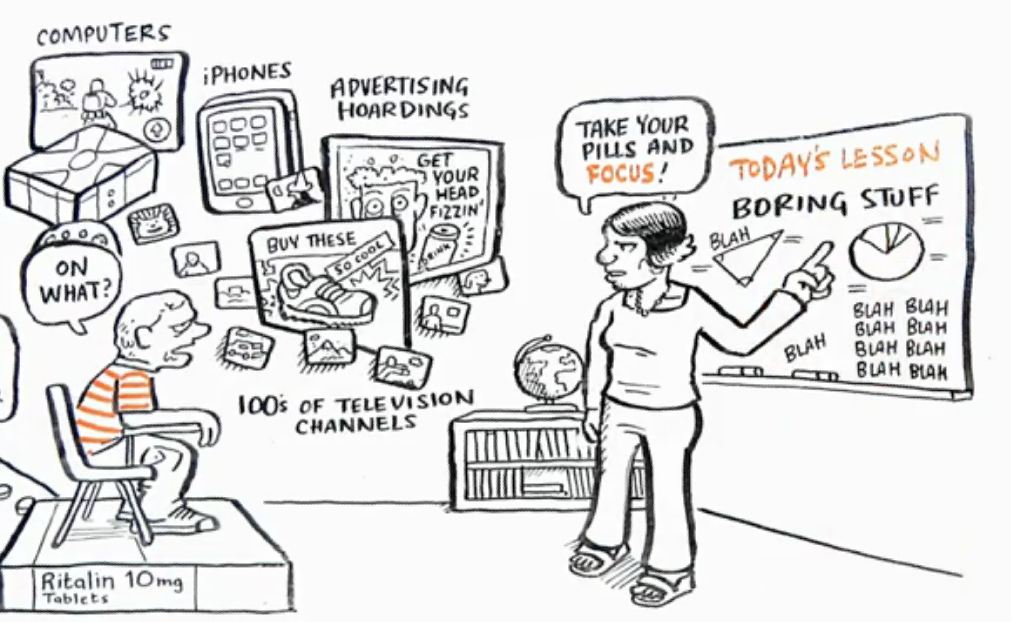
I also wonder whether catering to our students' 24/7 connection to technology is all good. In a speech given at the RSA, Sir Ken Robinson makes the following statement, "Our children are living in the most intensely stimulating period in the history of the earth. They're being besieged with information and calls to their attention from every platform; computers, iphones, advertisements, and hundreds of television channels. And we're penalizing them for getting distracted..."


If anything, this statement makes me wonder whether many kids (and adults!) today haven't developed an unhealthy addiction or over-dependance on technology. If our constant exposure to technology makes it difficult for us to commit to and focus on a single task, or results in us being disconnected from what's happening around us in the here and now, is that really a good thing? I can't tell you how many individuals I've talked to who've commented on the fact that while we now have the capacity to build larger and larger electronic social networks, many of us seem to be losing touch with the people immediately present around us, who we interact with in our daily lives. After all, how many of us have tried to carry on a conversation with someone only to have them be texting or checking facebook on their iphone the entire time they're talking to us.

Yes, technology provides students with some incredible possibilities for learning and connection, but perhaps this should be tempered with fostering healthy relationships and connections with the "flesh and blood" individuals who inhabit their physical lives. Maybe in this age of over-digitalization part of our role as instructors should be not only to help students use technology as a tool for learning, but also to help them "unplug" and relearn how to engage in healthy, non-digital interactions.