This blog showcases the various technology tools that can be used for pedagogical purposes in the second language classroom.
Showing posts with label technological change. Show all posts
Saturday, September 29, 2012
A Brief Introduction to Connectivism
According to George Siemens' learning theory of Connectivism, technology development over the last twenty years has drastically reorganized the way we live our lives, how we communicate with each other, and as a result, also the way we learn. Siemens points out that while today's most common learning theories, such as behaviorism, cognitivism, and constructivism define learning as something that occurs inside the individual, "these theories do not address learning that occurs outside of people (ie. learning that is stored and manipulated by technology). They also fail to describe how learning happens within organizations." In today's world of ever increasing technological development communication, dialogue, and interaction between learners more often than not occur through the medium of technology, rather than within the four walls of the traditional classroom. No longer does it make sense to think of today's learners in individualistic terms. Rather, today's "connected" learner can more accurately be thought of as a single thread within an intricately woven piece of fabric, or a tapestry. This tapestry is not a finished work but rather a "work in progress" that is constantly and continuously being added to and expanded.

Just as a beautiful tapestry is woven as many different pieces of thread coming from different directions become intertwined with each other, so learning also occurs as individuals from a variety of backgrounds cross paths, share ideas, and dialogue with each other. Just as some of the most beautiful and intricate tapestries are those woven from a huge diversity of colors and textures, so also diversity of perspectives, experiences, and ideas is key to the learning that occurs between individuals. The various pieces of thread in an intricate tapestry work together to bring out color and nuance in each other. In the same way, individuals not only gain knowledge from each other through dialogue, but also often gain a greater understanding of the knowledge they already possess. This is one of the key points Siemens makes in a youtube video entitled The Impact of Social Media on Learning. He also states that today's technology tools allow learning to occur in a way that's both effortless and very human. "If you think about it," Siemens says, "most of us enjoy dialogue, most of us enjoy conversation. We're social beings." Rather than reducing learning to something that occurs apart from this, connectivism claims that learning in today's rapidly changing world can hardly occur without it.
Friday, September 14, 2012
Cellphones, Ipads, and the Digital Learner: A Call for Reflective Use of Classroom Technology
Did you know...

If facebook were a country, it would be the third largest in the world?
There are over 12 billion searches performed on google each month?
The number of text messages sent and received daily now exceeds the total population of the human planet?
Now that you know, how will you let it inform your teaching? One youtube video entitled Pay Attention suggests having students text individuals outside their school to gather data for the class to use in lessons on topics like graphing, food preparation, and economic trends. Since we live in an age of digital learners, this video argues, why not use the technology our students love to engage our students and teach them more effectively? Another thought provoking video, Did You Know? calls attention to the rapid technological change going on in the world today and points to the need to prepare students for jobs that don't yet exist and that will utilize technologies that haven't yet been invented.
I appreciate the arguments these videos make about the urgency of incorporating technology in the twenty-first century classroom in a way that is relevant and engaging. Yet there is also a part of me that isn't fully convinced of the feasibility of their argument given the population of students I'm likely to work with.
Technology can be extremely expensive. If Buffalo private schools like Elmwood Franklin, where most of the students are middle class and Caucasian, can afford to put ipads into the hands of all their students, this is hardly the case in most of the schools attended by children of color on Buffalo's East and West Sides. Rather, in many of these classrooms, teachers have to reach into their own pockets just to purchase basic classroom supplies, not to speak of expensive technology. The students in these mostly low-income neighborhoods, and especially those who are recent immigrants and refugees may not have personal cell phones, ipods, or internet access at home, as these videos seems to suggest every teenager today does. It makes me wonder whether technology is just another area which will continue to accentuate the gap between the "haves" and the "have nots" in our society.
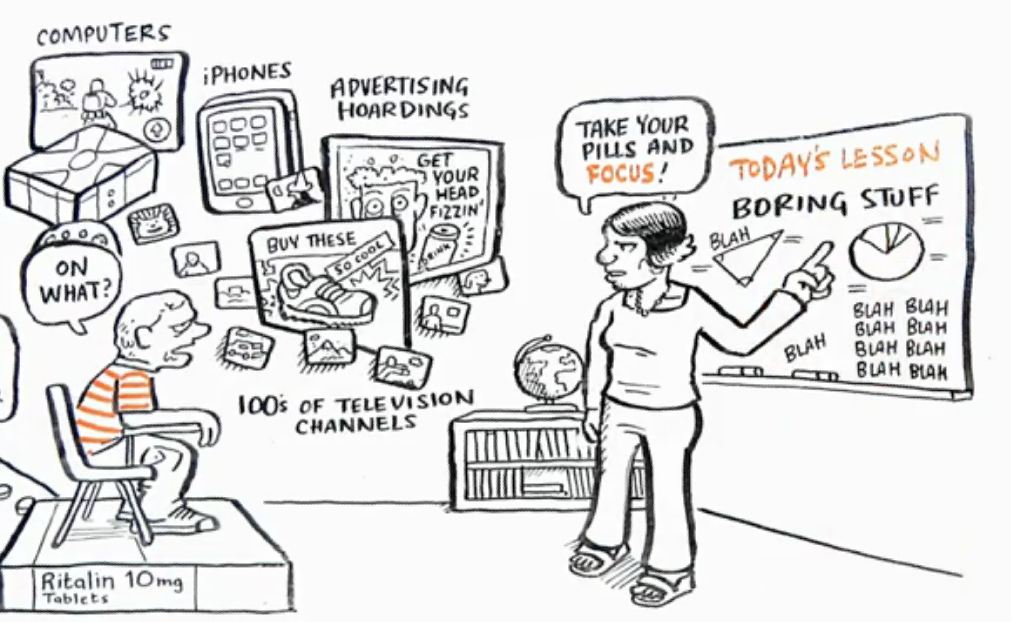
I also wonder whether catering to our students' 24/7 connection to technology is all good. In a speech given at the RSA, Sir Ken Robinson makes the following statement, "Our children are living in the most intensely stimulating period in the history of the earth. They're being besieged with information and calls to their attention from every platform; computers, iphones, advertisements, and hundreds of television channels. And we're penalizing them for getting distracted..."
If anything, this statement makes me wonder whether many kids (and adults!) today haven't developed an unhealthy addiction or over-dependance on technology. If our constant exposure to technology makes it difficult for us to commit to and focus on a single task, or results in us being disconnected from what's happening around us in the here and now, is that really a good thing? I can't tell you how many individuals I've talked to who've commented on the fact that while we now have the capacity to build larger and larger electronic social networks, many of us seem to be losing touch with the people immediately present around us, who we interact with in our daily lives. After all, how many of us have tried to carry on a conversation with someone only to have them be texting or checking facebook on their iphone the entire time they're talking to us.
Yes, technology provides students with some incredible possibilities for learning and connection, but perhaps this should be tempered with fostering healthy relationships and connections with the "flesh and blood" individuals who inhabit their physical lives. Maybe in this age of over-digitalization part of our role as instructors should be not only to help students use technology as a tool for learning, but also to help them "unplug" and relearn how to engage in healthy, non-digital interactions.
If facebook were a country, it would be the third largest in the world?
There are over 12 billion searches performed on google each month?
The number of text messages sent and received daily now exceeds the total population of the human planet?
Now that you know, how will you let it inform your teaching? One youtube video entitled Pay Attention suggests having students text individuals outside their school to gather data for the class to use in lessons on topics like graphing, food preparation, and economic trends. Since we live in an age of digital learners, this video argues, why not use the technology our students love to engage our students and teach them more effectively? Another thought provoking video, Did You Know? calls attention to the rapid technological change going on in the world today and points to the need to prepare students for jobs that don't yet exist and that will utilize technologies that haven't yet been invented.
I appreciate the arguments these videos make about the urgency of incorporating technology in the twenty-first century classroom in a way that is relevant and engaging. Yet there is also a part of me that isn't fully convinced of the feasibility of their argument given the population of students I'm likely to work with.
Technology can be extremely expensive. If Buffalo private schools like Elmwood Franklin, where most of the students are middle class and Caucasian, can afford to put ipads into the hands of all their students, this is hardly the case in most of the schools attended by children of color on Buffalo's East and West Sides. Rather, in many of these classrooms, teachers have to reach into their own pockets just to purchase basic classroom supplies, not to speak of expensive technology. The students in these mostly low-income neighborhoods, and especially those who are recent immigrants and refugees may not have personal cell phones, ipods, or internet access at home, as these videos seems to suggest every teenager today does. It makes me wonder whether technology is just another area which will continue to accentuate the gap between the "haves" and the "have nots" in our society.
I also wonder whether catering to our students' 24/7 connection to technology is all good. In a speech given at the RSA, Sir Ken Robinson makes the following statement, "Our children are living in the most intensely stimulating period in the history of the earth. They're being besieged with information and calls to their attention from every platform; computers, iphones, advertisements, and hundreds of television channels. And we're penalizing them for getting distracted..."
If anything, this statement makes me wonder whether many kids (and adults!) today haven't developed an unhealthy addiction or over-dependance on technology. If our constant exposure to technology makes it difficult for us to commit to and focus on a single task, or results in us being disconnected from what's happening around us in the here and now, is that really a good thing? I can't tell you how many individuals I've talked to who've commented on the fact that while we now have the capacity to build larger and larger electronic social networks, many of us seem to be losing touch with the people immediately present around us, who we interact with in our daily lives. After all, how many of us have tried to carry on a conversation with someone only to have them be texting or checking facebook on their iphone the entire time they're talking to us.
Yes, technology provides students with some incredible possibilities for learning and connection, but perhaps this should be tempered with fostering healthy relationships and connections with the "flesh and blood" individuals who inhabit their physical lives. Maybe in this age of over-digitalization part of our role as instructors should be not only to help students use technology as a tool for learning, but also to help them "unplug" and relearn how to engage in healthy, non-digital interactions.
Subscribe to:
Posts (Atom)