Showing posts with label education. Show all posts

Sunday, November 4, 2012

Digital Bookmaking: Bringing Students' Stories to Life

How do you help students who have never learned how to read and write in their first language make the connection between written text and spoken language? I think this has to be one of the biggest challenges instructors working with beginner-level adult refugee students face. Recently, I've been trying out something called the Language Experience Approach, or LEA for short, and I've had some encouraging results.


 LEA begins with a group activity or experience, such as a class field trip to a nearby neighborhood location or a cooking lesson. The instructor takes pictures during the activity, and with the help of the pictures, students come up with a story about the experience they've just shared. The students take turns adding to the story to tell what happened, while the instructor writes down what they say, word for word. The class can then spend the next few classes using the words in the story in different activities to practice skills like spelling, phonics, pronunciation, sight words and sentence formation. What works well about this approach is that you are basing your instruction in language students are already familiar with as well as connecting this language to a real life experience. To get a clearer idea of what LEA looks like, check out this video.

One of the LEA stories the students in my classroom have written is about a field trip we took this summer on the Buffalo Garden Walk. Most of my students are very interested in gardening, and several have their own garden plots in the summer, or at least grow a few vegetables in containers in their back yards. I thought it would be interesting for them to see some of the other gardens in their community as well to have the chance to meet and practice using English with some of their American neighbors. During the trip we took pictures, and afterwards my students created a story made up of sentences they told about all of the pictures. Even my most shy student was able to contribute a sentence, and therefore have an important role in the story writing. As students were telling the story, I wrote it out on a large piece of chart paper, and had the students who were able to copy it out in their notebooks (I typed up a copy for students who weren't able to do this). This story became the basis of our sight word practice, word study, and phonics instruction over the next few class sessions.

Now here's where digital bookmaking comes in. LEA is great because it helps students make a connection between spoken language that they can understand and written language that they can't yet read. This happens first of all when pre-literate students hear one of their classmates saying a phrase and watch the instructor writing the phrase down. It should also happen during the various follow-up activities that are based on the vocabulary and sentences in the story. A digital bookmaking tool like Bookr or Bubblr can further reinforce the connection between written text, spoken language, and meaning. 


Depending on the technology available in the classroom as well as students' familiarity and level of comfort with using it, the instructor can either create on her own, or have students help her create a digital flipbook that juxtaposes the pictures from the trip with the sentences the students have generated for each of them. For example, the instructor might add an image to the book and have a student volunteer to tell her the sentence that goes with that image, or conversely, type and read a sentence and have a student pick out the image that goes along with it. This gives the students another opportunity to hear each of the sentences being read while also seeing them in writing.

Another variation on this, which comes closer to digital storytelling, might be to use a tool like imovie to create a slideshow that includes images, audio and text, allowing students to hear the story being read while seeing the corresponding pictures and sentences that go with each sentence. I experimented with both of these tools to see how they would work with the LEA story my students wrote. Here's what I came up with!


In addition to helping reinforce the connection between spoken and written language, another objective of using a digital bookmaking tool with the Language Experience Approach might be to build students' self-confidence as writers. How empowering for students who have never had the chance to learn how to read and write in their first language to see their own words published in a book, even if it's just a digital book, for now.

Digital Storytelling: Giving Voice to Student Stories

ruaha_jonarensenOne of my most memorable classes as an undergraduate student was the Intro to Anthropology class I took with a professor called Dr. Arensen. Having spent over half of his life in East Africa, Dr. A., as the students called him, had a wealth of knowledge and experiences to share and was an incredible story teller. Most of our lectures consisted of a story or series of stories that illustrated the aspect of culture we were learning about that day. Gender roles. Rites of passage. African Traditional Religion. Although I've forgotten a lot of what I've learned in my undergraduate college classes, I still remember vividly many of the stories Dr. A. told and the cultural lessons that accompanied them.

There is something incredibly compelling and memorable about storytelling as a medium of communication. This week, I learned about a tech tool that can be used to both capture stories and share them with a digital audience: Digital Storytelling. As defined by the Educause Learning Initiative, "digital storytelling is the practice of combining narrative with digital content including images, sound, and video to create a short movie, typically with a strong emotional component."

With its range of formats, digital storytelling holds endless possibilities for use both in and outside of the classroom. The University of Houston's Educational Uses of Digital Storytelling site suggests how this medium might be used in an ESL classroom for the purpose of vocabulary building, with the instructor creating a slideshow that presents an image of each new vocabulary term accompanied by both the written and spoken form of the word. This slideshow could be viewed individually by students for further practice, either on the classroom computers, or possibly, on their computers at home. Or, assuming the classroom were equipped with the appropriate technology, the instructor could have the students themselves participate in the process of creating a digital story, like Maria's. I imagine it could be a very empowering experience for students to be given the tools to to share stories about themselves, their families, the countries they come from, or their experience in the United States with their peers using the multiple modalities available in digital story telling.

Student in the Computer Room

Another aspect of digital storytelling that intrigues me is its potential for being used outside of the classroom to educate individuals about issues and causes. The nonprofit organization I work at, Jericho Road Ministries, has used digital storytelling with images and audio to give voice to some of the incredible individuals in our community who have come as refugees from countries like Burma, Congo, Somalia, and Bhutan, and to share these with the wider Buffalo community on the following blog. More recently, our medical branch has also launched an audio-documentary series on the website Causes.com, sharing the stories of patients and community members to advocate for healthcare reform. These stories, like Raleigh's below, are a much more compelling way of educating voters about the impact of healthcare legislation on individuals with the least access to medical care than a list of statistics about the inequities of the current healthcare system.


Similarly, the Center for Digital Storytelling works with various groups and organizations to raise awareness and educate individuals about issues such as discrimination, gender-based violence, volunteerism, and HIV/AIDS through the sharing of digital stories. As sharing stories connected to issues like these can be a sensitive matter, I appreciated that this site also included a page on Ethical Practice in Digital Storytelling. I think these issues of ethics are especially important to keep in mind when working with vulnerable populations and with those whose stories include traumatic or deeply personal experiences. This page suggested that digital storytelling may not be appropriate with individuals displaying symptoms of PTSD, which makes me think it should be used with caution with students who are refugees.

Tuesday, October 16, 2012

Serious Games: An Oxymoron?


A serious game is a game whose purpose is not primarily to entertain, but instead to solve a problem or sometimes, provide a simulation. In my exploration of the various "serious" games out there, I was surprised to find that there was even a game created by the UNHCR, the branch of the United Nations that works with refugees and other forcibly displaced peoples across the world. As I spend a lot of my time working with and teaching refugees who have been resettled to Buffalo, this piqued my interest right away.

Against All Odds describes itself as "the game which lets you experience what it is like to be a refugee." You pick a character and embark on a three-part quest, which includes fleeing persecution in your home country, crossing an international border, and finally starting life over in a new country. Depending on the decisions you make and your ability to evade those who are trying to harm you, you may or may not make it. The game is broken up into several segments and I played most of these, several of them multiple times. 

This isn't a game I would use with English Language Learners who are themselves refugees. Rather, I could see using it with American students learning about global issues. One part of the game that I particularly liked was an activity toward the end, during which your character walks around a mall trying to buy a cellphone and you hear people talking about you. Some people express suspicion, resentment and ignorance about you as a refugee and what you're doing in their country, while others have a more informed perspective and welcoming attitude. I think this activity shows particularly well the range of perspectives and attitudes towards the refugees who make their new homes in our country, and could be particularly helpful for building students' sensitivity to these new members of their community. 

One challenge serious games like Against All Odds face is to help players understand issues that are real and serious without trivializing them. For example, any excitement or adrenalin you might feel as you try to dodge the secret police while running across a dark city in Against All Odds is nothing like actually running for your life from people who are trying to kill you and your family. In the game when you make a wrong decision or get caught by the bad guys there are an infinite number of opportunities to start over. In real life there aren't. 
The last thing I would want is for students playing a game like this to walk away from it with the idea that now they know what it's like to be a refugee. (And, as you can guess, for this reason I'm not the biggest fan of the game's tagline). Instead, I hope that what a game like this could help students start to do is to imagine themselves in the shoes of these people who are coming to their country, and to realize that refugees are people just like them, except they are people who have experienced the unimaginable. 

I think this game would be a great jumping off point for a middle school global issues class about to begin a unit studying about world conflict or refugees. The game could be assigned to students for homework, and students required to write a journal entry about their game character's journey to allow the instructor to assess that the activity learning objectives had been met. This homework assignment could be followed up by a class discussion, and students could be asked to identify a specific part of the world or a specific part of a refugee's journey to do more research on and then share with the rest of the class. The unit could even end with a service learning opportunity at a local organization that works with resettled refugees.

Virtual Burgers and Refugee Learners


A couple of years ago, my little brother, a self-professed online game addict, introduced me to a series of point-and-click games with a common theme: food preparation. These games included Papa's Pizzeria, Papa's Burgeria, and Papa's Taco Mia, among many other variations! Your role in each of these games is the same. You are a worker at a fast food franchise (a pizzeria, taco shop, burger place, etc...) and your goal is to earn tip money by taking and accurately fulfilling your customers orders. The funny thing was that although I used to work at a fast food restaurant and did not enjoy it, there was something about these games that kept me playing one round after another.


"One of the defining attributes of any game," says Zac Hill in a post entitled Sculpting Flow and Fiero, "is that it is, in some sense, voluntary work." He goes on to say that there is something about the way games make people feel that intrinsically motivates people to continue doing this "voluntary work," whether that work is killing zombies, figuring out a way to escape a room, or making virtual tacos. I think it must be this realization that is, at least in part, behind the recent trend toward Gamification in education, business, and other arenas.

The nonprofit organization Educause describes gamification as "the application of game elements in non-gaming situations, often to motivate or influence behavior." In  7 Things You Should Know About Gamification it describes how games provide intrinsic motivation to their participants by offering immediate feedback, an appropriate level of challenge, and rewards. A rationale behind the move towards gamification in the field of education specifically is that incorporating game-like elements like these into teaching holds promise for creating more intrinsic motivation for our students to learn as well as helping them see coursework less as a chore and more as a challenge.

In light of the move towards both gamification and the integration of technology in current educational practice, some instructors might decide to incorporate not just game-like elements but computer games themselves into their classroom instruction. This brings us back to the example of Papa's Burgeria.

I imagine an adult ESL instructor seeking to incorporate more technology and more game-like elements into her classroom might choose to use a game like Papa's Burgeria during a unit on employment and food services. The language objectives of using this game in the classroom could be for students to practice giving and receiving commands using the correct command form of verbs and food preparation vocabulary. For many refugees and immigrants, their first job in the US could likely be in the area of food preparation, which would make a knowledge of this vocabulary relevant. In an ESL classroom with a computer lab, pairs of partners could play this game together, taking turns giving commands to each other.


In order to prepare her students to play this game, the instructor could introduce vocabulary such as hamburger, lettuce, ketchup, pick up, and flip to her students and have them practice it using TPR or other similar activities. When introducing food vocabulary, she might use both photographs of the actual items as well as the visual representation used for these items in the game, to help students  make the connection between the real item and its "cartoon" version. She could then have them pair up with a partner and go to a computer. One partner would play the game while the other partner gave him or her instructions on what to do, based on each customer's order (ie. pick up the bun, flip the burger, add ketchup, etc...) After each round, students could switch roles so that both partners would have the opportunity to practice both giving and receiving commands. During the activity, the instructor could circulate around the room, using a checklist to mark off whether each of the students giving instructions was using the correct verbs and nouns matching the images on the screen.


The reason I write about this example in third person is that although I consider it a way of incorporating game-like elements and technology into the language classroom, I would have reservations about actually using an activity like this with the students I teach. Most of the refugee adult students I teach have had and continue to have limited exposure to technology. Using a computer for them, period, is something scary and challenging and not very comfortable. I have a hard time seeing them pick up a new computer game as easily and effortlessly as their thirteen-year-old son would, for example. I'm afraid that rather than creating a positive atmosphere, a computer game like Papa's Burgeria might result in anxiety and frustration, raising the affective filter and taking away from their language learning experience. I also worry that providing students with all the background information needed to play a game like this successfully may just take up too much classroom time to be worth the potential language gains that may result from it.

All that to say, while computer games may not be the best fit for the adult refugee ESL class room, I do think there are many game-like elements such as maintaining an appropriate level of challenge, giving immediate feedback, and even providing opportunities for some healthy classroom competition that can be a great way of increasing motivation and success experienced by refugee adult learners.

Friday, September 14, 2012

Cellphones, Ipads, and the Digital Learner: A Call for Reflective Use of Classroom Technology

Did you know...


 If facebook were a country, it would be the third largest in the world?


There are over 12 billion searches performed on google each month?


The number of text messages sent and received daily now exceeds the total population of the human planet?


Now that you know, how will you let it inform your teaching? One youtube video entitled Pay Attention suggests having students text individuals outside their school to gather data for the class to use in lessons on topics like graphing, food preparation, and economic trends. Since we live in an age of digital learners, this video argues, why not use the technology our students love to engage our students and teach them more effectively? Another thought provoking video, Did You Know? calls attention to the rapid technological change going on in the world today and points to the need to prepare students for jobs that don't yet exist and that will utilize technologies that haven't yet been invented.


I appreciate the arguments these videos make about the urgency of incorporating technology in the twenty-first century classroom in a way that is relevant and engaging. Yet there is also a part of me that isn't fully convinced of the feasibility of their argument given the population of students I'm likely to work with.

Technology can be extremely expensive. If Buffalo private schools like Elmwood Franklin, where most of the students are middle class and Caucasian, can afford to put ipads into the hands of all their students, this is hardly the case in most of the schools attended by children of color on Buffalo's East and West Sides. Rather, in many of these classrooms, teachers have to reach into their own pockets just to purchase basic classroom supplies, not to speak of expensive technology. The students in these mostly low-income neighborhoods, and especially those who are recent immigrants and refugees may not have personal cell phones, ipods, or internet access at home, as these videos seems to suggest every teenager today does. It makes me wonder whether technology is just another area which will continue to accentuate the gap between the "haves" and the "have nots" in our society.

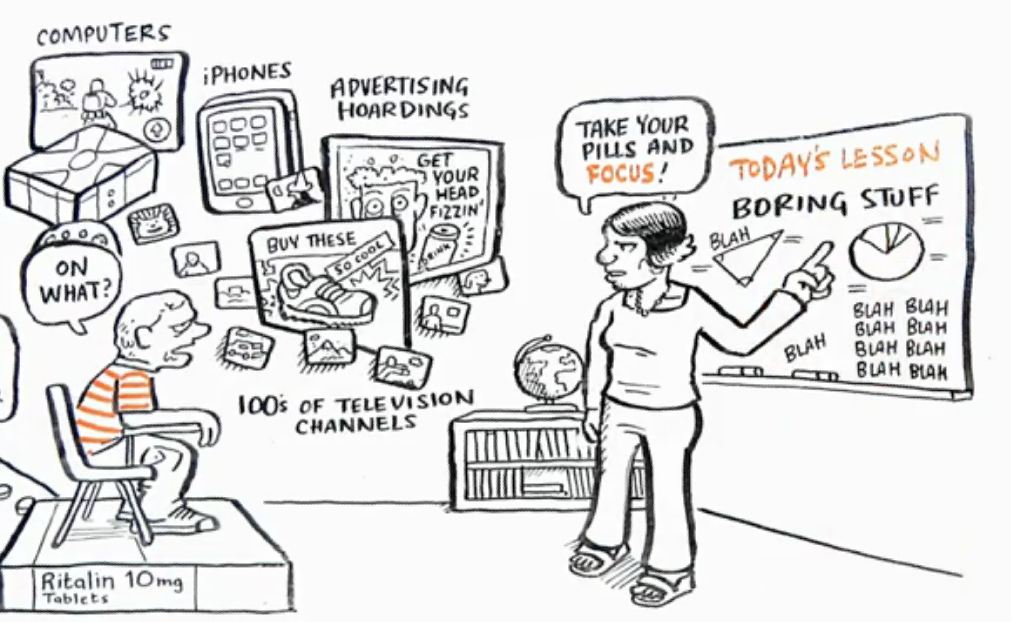
I also wonder whether catering to our students' 24/7 connection to technology is all good. In a speech given at the RSA, Sir Ken Robinson makes the following statement, "Our children are living in the most intensely stimulating period in the history of the earth. They're being besieged with information and calls to their attention from every platform; computers, iphones, advertisements, and hundreds of television channels. And we're penalizing them for getting distracted..."


If anything, this statement makes me wonder whether many kids (and adults!) today haven't developed an unhealthy addiction or over-dependance on technology. If our constant exposure to technology makes it difficult for us to commit to and focus on a single task, or results in us being disconnected from what's happening around us in the here and now, is that really a good thing? I can't tell you how many individuals I've talked to who've commented on the fact that while we now have the capacity to build larger and larger electronic social networks, many of us seem to be losing touch with the people immediately present around us, who we interact with in our daily lives. After all, how many of us have tried to carry on a conversation with someone only to have them be texting or checking facebook on their iphone the entire time they're talking to us.

Yes, technology provides students with some incredible possibilities for learning and connection, but perhaps this should be tempered with fostering healthy relationships and connections with the "flesh and blood" individuals who inhabit their physical lives. Maybe in this age of over-digitalization part of our role as instructors should be not only to help students use technology as a tool for learning, but also to help them "unplug" and relearn how to engage in healthy, non-digital interactions.